Background
I've spent a ridiculous amount of my life handing my digital life over to somebody else as most people have done over the years.
Google has my photos and devices. Someone else has my files. Someone else has my movies. Someone else knows what websites I'm visiting. Someone else is storing my recipes.
And if the service disappears, changes its pricing, changes its terms, or decides that something I have been doing for years is no longer supported?
Well... apparently that's my problem. I've decided I don't like that arrangement anymore. So I'm slowly taking back control. Not everything. I'm not about to build my own cellular network or start manufacturing my own iPhone in the garage. But the things I can host myself? I'm doing it.
And this is where my little unRaid server comes in.
Why I'm moving away from the big guys
Let's be clear: Google, Apple, Microsoft, Amazon and the other big technology companies make some fantastic products. I've used them for years. They're convenient. That's the problem. Convenience is incredibly addictive. Google Photos is easy, iCloud is easy, Google Drive is easy, ... is easy.
Cloud services are designed to make you forget where your data actually lives. You take a picture and it magically appears on all your devices. You save a document and it's magically available everywhere. You turn on a smart light and it magically works from your phone. It's fantastic. Until you start asking yourself:
- Where is my data?
- Who controls it?
- What happens if I stop paying?
- What happens if the company changes the service?
- What happens if the account gets locked?
And perhaps most importantly:
- Why am I paying somebody else to store data on hardware that I could own?
That's the question that started this whole project for me and...
I'm Canadian. I Want More Control Over My Digital Life.
There's another part of this that is important to me. I'm Canadian. I live in Canada, work in Canada, have built my life here and well, the orange turd.
Yet an enormous amount of my digital life exists inside American technology companies. Again, there isn't anything inherently wrong with that. But I've started thinking more about digital sovereignty.
If I can keep my photos, documents, home automation, movies, recipes, website and other personal information inside my own house, on hardware that I own, why wouldn't I?
I don't need Silicon Valley to store everything for me. I can build my own little corner of the internet right here in Canada. And honestly, that's pretty cool.
I'm not trying to completely disconnect from the United States, who am I kidding, I am but it's most likely impossible.
I'm trying to reduce as much of my dependence as possible on companies that I don't control.
One service at a time.
My Home Server
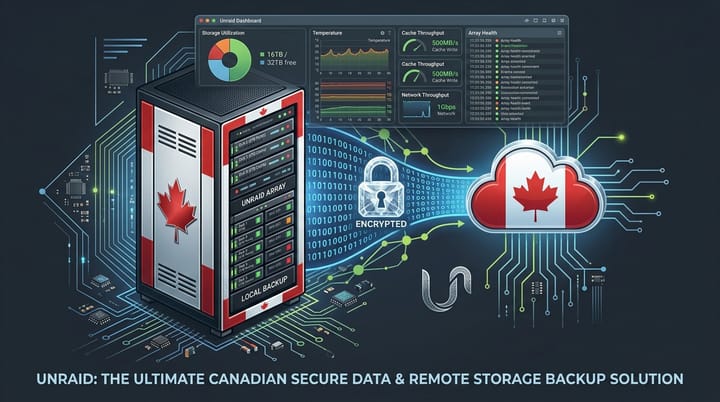
The centre of this experiment is my unRaid server. It's basically becoming my own little private cloud. Instead of having a collection of unrelated subscriptions and cloud services, I'm running applications on hardware sitting in my house.
That means I own the hardware.
- I control the storage.
- I control the accounts.
- I control the backups.
- I control the updates.
And, when something breaks...
- I get to fix it.
Which is both the best and worst part.
Google Photos → Immich

One of the biggest changes for me is replacing Google Photos with Immich. Immich is essentially my own private Google Photos.
It gives me:
- Automatic photo uploads
- Mobile apps
- Facial recognition
- Object recognition
- Albums
- Search
- Timeline views
- Video support
- Sharing
- Web access
And the important part?
My photos are stored on my server. I'm no longer uploading every family photo to somebody else's cloud and hoping the company continues offering the service I want. Immich is particularly impressive because it doesn't feel like some old-school self-hosted application.
It feels like a modern photo service.
The Immich developers currently recommend Docker Compose for production installations, and their documentation specifically recommends keeping the PostgreSQL database on local storage rather than a network share.
That's exactly the sort of application I want running on my server.
- My photos.
- My storage.
- My rules.
Of course, this doesn't mean I suddenly stopped backing up my photos. Self-hosting is not a backup strategy. I'm still keeping backups. I'm just choosing where the primary copy lives.
Google Drive / OneDrive → Nextcloud
The next big replacement is cloud storage. Nextcloud gives me the ability to create my own private cloud for:
- Documents
- Files
- Photos
- Sharing
- Calendars
- Contacts
- Collaboration
I'm no longer renting storage, I'm buying storage, there's a difference.
Google Home → Home Assistant
This one is probably my favourite. I've become increasingly interested in smart-home automation, and Home Assistant is at the centre of it. Instead of having every smart device communicating with some manufacturer's cloud, Home Assistant lets me bring many of those devices together under one system that I control.
- Lights.
- Cameras.
- Sensors.
- TVs.
- Temperature sensors.
- Doorbells.
- Motion sensors.
- Washer and dryer
- Energy monitoring.
- Automations.
The possibilities are almost ridiculous.
And one of the biggest advantages is that Home Assistant can continue operating locally.
The Home Assistant team specifically describes the benefit as keeping the smart home working when the internet is down and keeping data at home. Home Assistant can also run as a container, although the Home Assistant OS installation is their recommended option for most users.
For me, running it on my existing server makes a lot of sense. If the internet goes down, I still want my lights to work. I still want my automations to run. I still want my cameras to be available.
My house shouldn't become dumb because eBox (Bell) is having a bad day.
Google Search / DNS Tracking → Pi-hole
This is another little piece of the puzzle. Pi-hole acts as a network-wide DNS sinkhole. In simple terms, I can use it to block advertising and tracking domains for devices throughout my house. Instead of installing an ad blocker separately on every computer, phone and TV, I can block many unwanted requests at the network level.
Pi-hole can also be run in Docker, which makes it a natural fit for my unRaid server. (this was a lesson to be learnt and will be an additional post on pi-hole)
It's another example of something that used to be: "Somebody else's service." becoming: "Something running in my house."
Google / Cloud Recipes → Mealie
This one might seem ridiculous. And that's exactly why I love it. I have a recipe website and I use recipes all the time. So why should my recipes need to live in somebody else's cloud? Mealie gives me my own self-hosted recipe manager. I can store:
- Recipes
- Ingredients
- Meal plans
- Shopping lists
- Categories
- Household favourites
It's not exactly going to bring down Google but that's not the point. Self-hosting isn't about replacing Google overnight. It's about asking: "Why does Google need this?" If the answer is "it doesn't," I have an opportunity.
Ring / Cloud Cameras → Frigate
Security cameras are another area where I want local control. That's where Frigate comes in. Frigate is a local NVR designed around IP cameras and object detection. Instead of sending camera footage to somebody else's cloud, I can record it locally. It can identify things like:
- People
- Cars
- Animals
- Motion
And it integrates beautifully with Home Assistant. Frigate is designed to run in Docker, and its documentation specifically covers running it on unRaid. This is particularly important to me as I don't want a camera pointed at my front door uploading every second of footage to some random cloud server. I'd rather have:
Camera → My Network → My Server → My Storage
My Website → My Server
And then there's this website, adamsooley.ca and acrossthecove.com. Why should my own website depend entirely on somebody else's hosting platform? I've already moved toward hosting my own website infrastructure. That means I can control:
- The website
- The database
- The files
- The backups
- The updates
- The domain configuration
I'm still using services like Cloudflare where they make sense. Self-hosting doesn't mean refusing to use the internet. It means deciding which pieces I actually need somebody else to manage.
The new setup
My digital life is starting to look something like this:
| What I Want | Traditional Cloud | My Alternative |
|---|---|---|
| Photos | Google Photos | Immich |
| Files | Google Drive / OneDrive | Nextcloud |
| Smart Home | Google Home / vendor clouds | Home Assistant |
| Recipes | Cloud recipe apps | Mealie |
| DNS / Ad Blocking | Browser extensions / ISP DNS | Pi-hole |
| Security Cameras | Cloud NVRs | Frigate |
| Website | Hosted platform | Self-hosted Ghost |
| Infrastructure | Someone else's servers | My Unraid server |
And this list will probably keep growing.
But isn't this a lot of work?
Yes. Absolutely. There is no point pretending otherwise.
If you want everything to "just work," Google and Apple are incredibly difficult to beat. You install an app, you sign in, Done.
With self-hosting, you're now responsible for:
- Hardware
- Storage
- Updates
- Security
- Backups
- Networking
- DNS
- Certificates
- Passwords
- Monitoring
- Disaster recovery
And occasionally you get to stare at a Docker container wondering why it suddenly decided that it doesn't want to start anymore. I've been there, more than once but I've learned something.
I actually enjoy it.
There's something satisfying about fixing a problem in your own infrastructure rather than opening a support ticket and waiting for someone else to fix it.
Self-hosting doesn't mean no cloud
This is an important distinction, I'm not trying to become a digital hermit. I still use Google, I still use cloud services, I still use the internet, and I still use Cloudflare.
I'm simply trying to move the things that I can reasonably own and operate back into my own hands. It's a spectrum. I don't need to go from: 100% cloud to 0% cloud overnight. Even moving from 100% dependence to 80% dependence is progress, then 70%, then 60%, and eventually, maybe I reach a point where the majority of my important personal data is sitting in my own house.
The Canadian Part
There's something satisfying about knowing that my little server is sitting here in Canada. My photos aren't sitting in some mysterious cloud that I have no idea how to access, my home automation isn't completely dependent on an American technology company, my movies aren't dependent on a subscription, my recipes aren't dependent on an app developer continuing to operate, and my website isn't dependent on a hosting company deciding what I'm allowed to do.
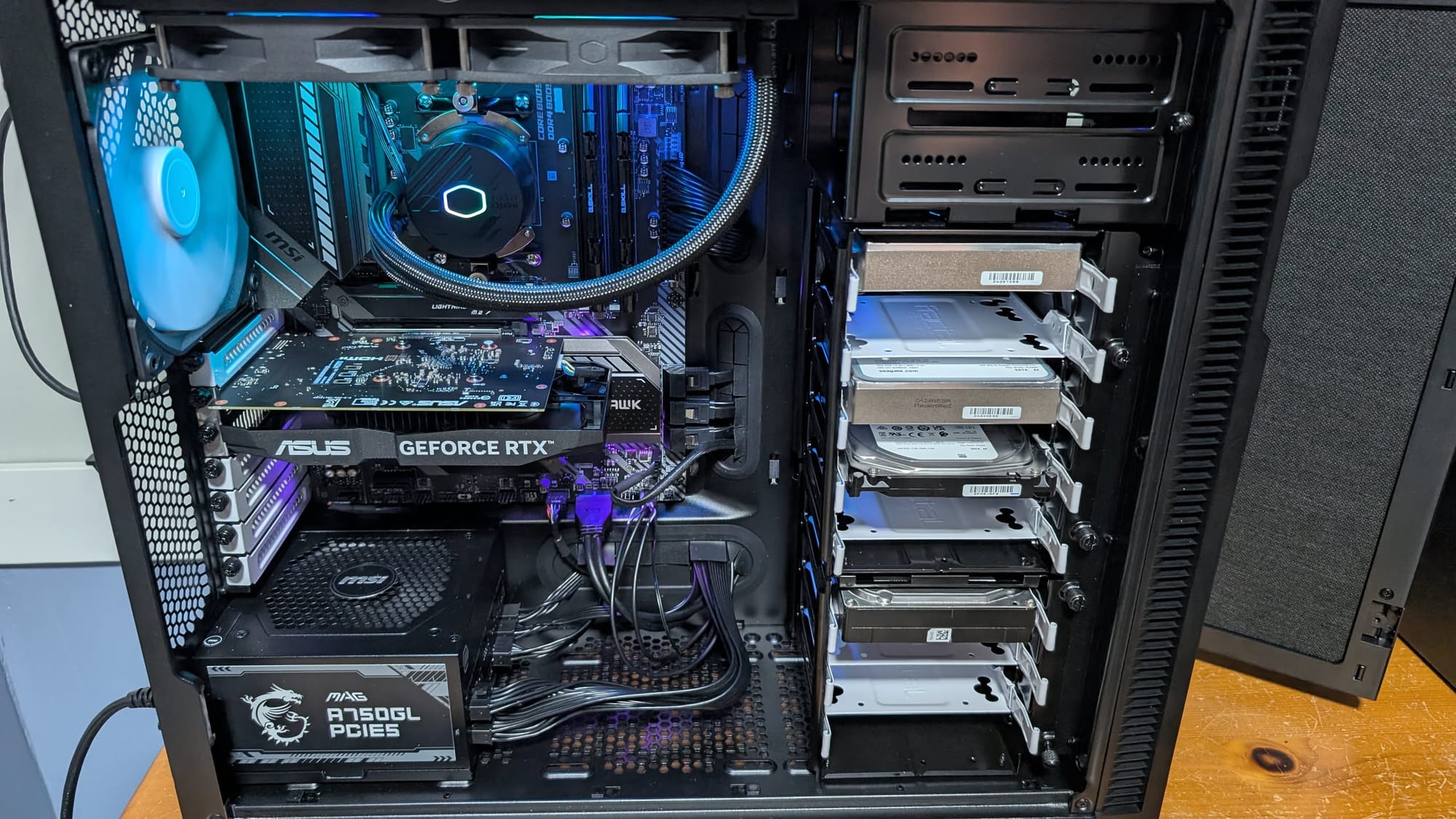
I've got a bunch of hard drives, a computer, an internet connection and a ridiculous number of Docker containers. It's not exactly a national infrastructure project, but it's mine, and maybe that's the point.
Canadian digital independence doesn't have to start with the government, it can start at home.
What's Next?
The next step is documenting how I built some this and where unRaid comes in. I'm going to show how I use unRaid as the foundation for running some of these services and building a reliable home network.
Because the goal isn't just to build a server. The goal is to build my own little private cloud, right here in Canada removing your reliance on American companies, and if I can do it, there's a pretty good chance you can too, all while boring you.
Next in the series: Setting up unRaid from a pile of hardware to a Canadian cloud